Will my child sit still for online speech therapy?
Online Speech Therapy Online Speech Therapy 8 min read
Your child does not need to sit still for online speech therapy. A well-run session fits the child’s age. A toddler plays with you while the speech pathologist coaches you. A young school-age child works on the screen in short, changing activities, and a teenager talks much as they would across a table.
Parents often rule out video sessions picturing a small child staring at a laptop for 45 minutes. That is not what an online session looks like. This guide covers engagement by age, how you can help, screen time, and whether a child can build a relationship with someone through a screen.
Does my child have to look at the screen the whole time?
No. A child in an online speech therapy session needs to be seen and heard for the parts that depend on it, such as saying a sound, answering a question or reading a line aloud. For the rest, getting up, fetching a toy and coming back is normal, as long as an adult is with a younger child.
Attention in young children comes in short bursts, and a session planned around those bursts asks far less of a child than sitting still would.
What does engagement look like at each age?
Engagement in online speech therapy changes with age far more than with the screen. A good session for a two year old looks nothing like one for a ten year old.
Under 3: your child plays, you are coached
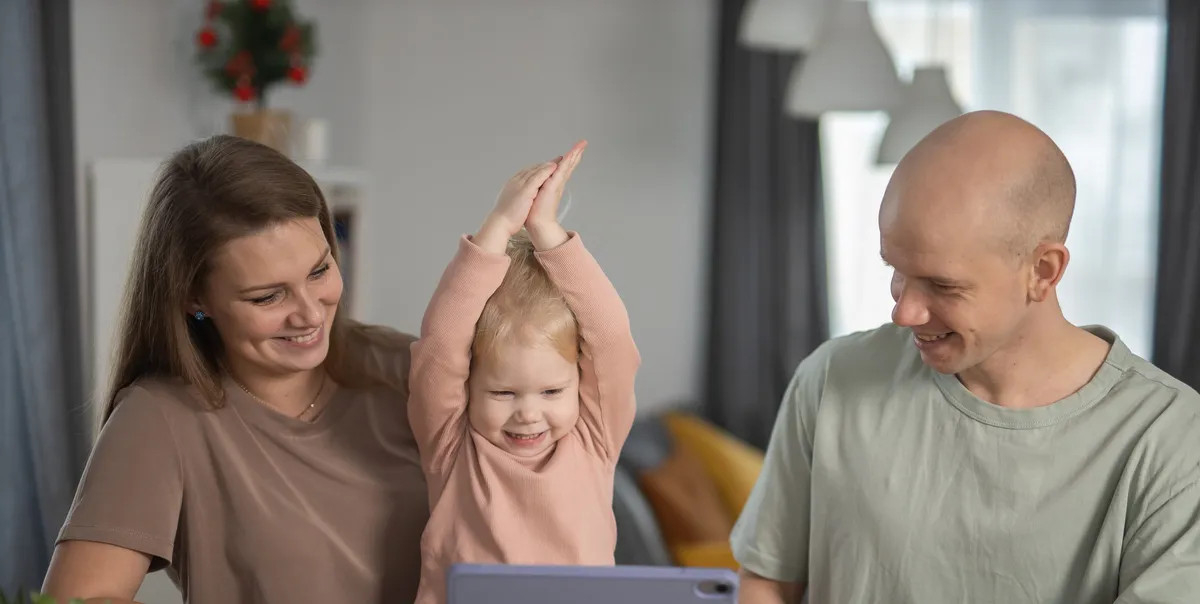
With a child under three, Dr Lauren Crumlish works mostly through the parent. Your toddler plays with you on the floor or at a low table with their own toys. Dr Lauren watches, tells you what she notices and suggests what to try next, as it happens. Your child may barely look at the screen, and the session still works, because the therapy is the play between you and your child.
The research on toddlers and video explains why the parent stays at the centre. Its results differ between studies. In the “Baby FaceTime” study, toddlers aged 22 to 25 months learned new words from a live video call but not from a recording of the same person (Myers and colleagues, 2017). In a later study of toddlers aged 24 and 30 months, children did not learn a new word from a person on video, even when that person answered them (Troseth and colleagues, 2018). What the studies point to more consistently is the parent: in a related study of children around 30 months old, toddlers learned more words from video when a parent beside them showed them how to respond (Strouse and colleagues, 2018). A toddler learns most from the adult in the room; Dr Lauren’s job is to coach that adult well. More on this age is on the page about online speech therapy for toddlers and late talkers.
3 to 7: short activities, with you close by
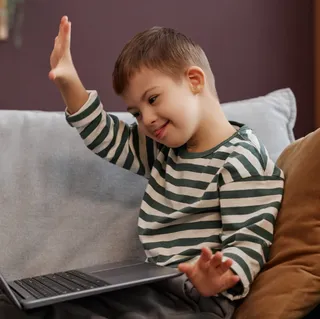
Children from about three to seven can usually take part directly for short stretches, with an adult within reach. A session at this age is a string of short activities. There might be a game on a shared screen, a picture to talk about, a favourite toy held up to the camera and a quick movement game between turns. A child who wanders is usually brought back by the next activity, not by being told to sit down.
You are close by to help with materials, move the device and step in when your child needs a hand.
8 and over: working directly with Dr Lauren
From about eight, most children can work with Dr Lauren directly for a whole session. Many already use a screen for school, so a video call is familiar. Teenagers often prefer some privacy, with a parent joining for part of the time; the page on online speech therapy for teenagers covers how that works.
What does Dr Lauren do to keep a child engaged on video?
Dr Lauren runs each session and adjusts it as she goes, so keeping your child engaged is her job, not yours. A speech pathologist working by video has a range of tools. She can change the activity before attention fades, give the child choices and build in movement. She can use the child’s own toys and interests, share the screen for games and pictures, or hand more of an activity to the parent. Which of these Dr Lauren uses depends on the child, and she plans around what she learns at the online assessment.
Autistic children vary widely in how they find video calls. Some find a familiar room and a predictable screen easier than a clinic; others need sessions shaped differently. The page on online speech therapy for autistic children explains how Dr Lauren approaches this.
How can I help keep my child engaged in telehealth sessions?
A few practical steps make a real difference to how an online session goes, especially for a child under eight.
Before the session
- Choose a time when your child is fed and rested, not straight after a long day.
- Use the same spot each week, with the television off and siblings busy elsewhere if you can manage it.
- Put the device on a steady surface at your child’s height. A laptop or tablet works better than a phone.
- Have ready any toys, books or materials Dr Lauren has asked for.
- Let an active child run around or play outside beforehand.
The detail on devices, internet and the room is on the page about what you need at home for a session.
During the session
- Sit beside a young child, a little to the side, so the camera sees their face.
- Follow Dr Lauren’s lead, and wait before answering for your child.
- Step back when she asks to work with your child directly.
- Tell her if something is off today, such as tiredness or a bad morning.
Is online speech therapy just more screen time?
For a young child, most of an online session is not the kind of screen time the guidelines warn about. Australia’s 24-Hour Movement Guidelines say sedentary screen time is not recommended under two. For two to five year olds, they set a limit of an hour a day, with less being better. The World Health Organization sets the same limits, gives watching television or videos and playing computer games as examples, and values interactive time with a caregiver, such as reading and puzzles.
For a young child, an online session is mostly that second kind of time: a parent and child playing and talking, with a speech pathologist coaching through the screen. The guidelines do not mention video calls with a real person either way.
Parents also ask whether screen time causes speech delay. A 2020 review of 42 studies found that more screen time went with slightly weaker language skills, while watching with a parent went with slightly stronger ones (Madigan and colleagues, JAMA Pediatrics). The links were small, and the studies could not show cause.
A live person who responds is also different from a show or an app (the guide to speech therapy apps compares the two), though the toddler studies above suggest that for the youngest children the parent in the room still matters most.
Will my child connect with Dr Lauren through a screen?
Rapport over video appears to hold up, but the research on it is thin. The study usually cited is Australian. Anneka Freckmann, Monique Hines and Michelle Lincoln at the University of Sydney asked 32 speech pathologists, 14 working by telepractice and 18 in person, to rate their rapport with child clients on a children’s therapeutic alliance scale. The scores did not differ between the two groups, and the authors concluded that telepractice does not appear to harm rapport between speech pathologists and children (International Journal of Speech-Language Pathology, 2017).
What the study cannot tell us matters as much. It measured the clinicians’ own ratings, not what children or parents felt. It was small, and the two groups saw different children. It shows that rapport by video is not obviously worse, not that it is the same for every child. What the wider research says about results is on the page does online speech therapy work?
What happens when a session goes badly?
A bad session is common and is not a sign that online therapy has failed. Children have off days on video just as they do in a clinic. When a child cannot settle, Dr Lauren may shorten an activity, hand more of it to you, switch to something easier, or end on a small success rather than push on.
After a hard session, think about what was different, such as the time of day, hunger or a sibling nearby. If sessions keep going badly over several weeks despite changes, talk to Dr Lauren about it. Sometimes video is not the right fit for a child at that point, and the guide is online speech therapy right for my child? sets out when in-person help is the better choice.
What should I do next?
If your child is under three, the page on online speech therapy for toddlers and late talkers explains how coached sessions work and what they cost. For the whole picture, from the first call to practice between sessions, see how online speech therapy works.
Dr Lauren works with a small number of families and has limited availability. Families who would like to work with her can apply, and our team will review your application.
Sources
- Australian Government Department of Health, 24-Hour Movement Guidelines: Birth to 5 years.
- World Health Organization, To grow up healthy, children need to sit less and play more, 24 April 2019.
- Myers, LeWitt, Gallo and Maselli, Baby FaceTime: can toddlers learn from online video chat?, Developmental Science, 2017.
- Troseth, Strouse, Verdine and Saylor, Let’s chat: on-screen social responsiveness is not sufficient to support toddlers’ word learning from video, Frontiers in Psychology, 2018.
- Strouse, Troseth, O’Doherty and Saylor, Co-viewing supports toddlers’ word learning from contingent and noncontingent video, Journal of Experimental Child Psychology, 2018.
- Madigan, McArthur, Anhorn, Eirich and Christakis, Associations between screen use and child language skills: a systematic review and meta-analysis, JAMA Pediatrics, 2020.
- Freckmann, Hines and Lincoln, Clinicians’ perspectives of therapeutic alliance in face-to-face and telepractice speech-language pathology sessions, International Journal of Speech-Language Pathology, 2017.
Topics
- Engagement
- Screen time
- Toddlers
- Getting started